Digital marketing in 2026: what companies need to change to remain visible and successful in the age of AI
Digital marketing is currently experiencing one of its biggest transformations since the arrival of social networks and mobile.
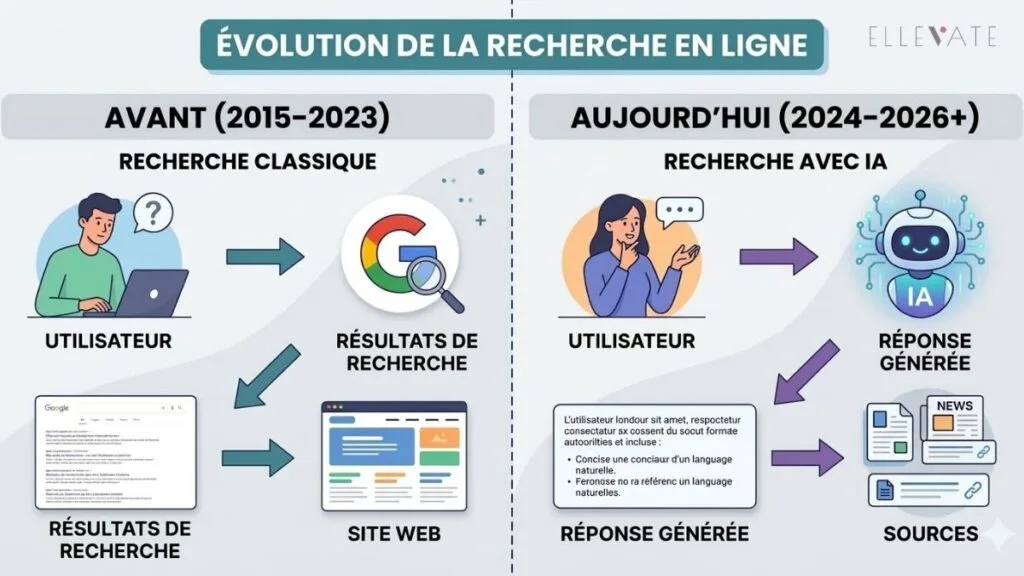
The rise of artificial intelligence engines is changing the way internet users search for information, discover businesses, and make decisions.
For a long time, digital visibility relied primarily on traditional Google results, a good social media strategy, etc. Today, things are changing rapidly with the democratization of conversational search interfaces (AI chats) which act as new acquisition channels for businesses.
Tools like Google AI Overviews , ChatGPT , Claude , and Perplexity now offer concise and personalized answers directly within the search interface. Users no longer search Google and the internet in general; they interact with an AI that provides targeted recommendations. This is marketing in the age of AI.
In concrete terms, what does this mean? Your visibility, your ability to be discovered by a potential customer, no longer depends on the well-known and established channels (Google, social media, Bing, etc.), but on a new channel: AI chat. This is the central challenge of your 2026 digital marketing strategy to ensure your continued existence and to be chosen by your customers. Your content must be understandable, credible, and easily analyzed by search engines.
What won't change in digital marketing in 2026
Despite technological advancements, the fundamental principles of digital marketing remain essential. An effective strategy still relies on solid foundations, clear and accessible content, and a connection with your audience.
A clear value proposition
Before any digital strategy, a company must be able to answer a simple question: Why should a customer choose your company over another?
The value proposition remains at the heart of any marketing strategy: who are we, what do we bring to our customers? The essential questions of any marketing strategy 10 years ago as today.
AI can transform information distribution channels, but it does not replace the relevance of an offer.
Useful and high-quality content
Search engines and AI systems do not create the content they promote. They aggregate existing content based on the search queries they receive.
In practical terms, the AI doesn't invent a recipe when you tell it about the leftovers in your fridge; it goes to relevant websites: Marmiton, vegan cooking, vegetarian specialties, what to do with leftovers, etc. Based on all these answers and what it knows about you, it creates a customized recipe. But if you look closely, it will tell you if some ingredients are missing or if certain things aren't quite right. So it hasn't "created" a recipe; it has chosen what is closest to the contents of your fridge and recommends it to you.
This is why producing useful, clear, and informative content remains essential for visibility and recommendations. This includes: blog articles, backlinks, comprehensive guides, FAQs, etc.
To understand the different possible approaches, you can consult our detailed guide on the different digital marketing strategies.
Solid technical SEO
Search engine optimization (SEO), which allows you to rank on Google, Bing, etc., remains a very important lever because its logic is similar (but not identical) to that of AI-driven SEO. We address the famous SEO vs. GEO question very clearly and concretely in this article.
A well-structured website should, in particular:
- be quick
- be accessible on mobile
- possess a clear architecture
- to enable efficient indexing by search engines
These elements are essential for being visible on Google, but also for being understood by AI engines. Because if the robot doesn't have access to your content, you could be the best, but no one will be able to see or know it.
Google states in its official documentation that AI systems use indexed web pages as one of their sources of data and content.
source: https://developers.google.com/search/docs/fundamentals/seo-starter-guide
A coherent editorial strategy
Publishing content regularly and in a structured way remains essential for increasing your visibility. And the content shouldn't be scattered but consistently aligned with your company, its positioning, and its values.
In concrete terms, your effective editorial strategy must:
- answering users' questions
- cover the key topics in your sector
- structure the content around strong themes
To go further, also discover why AI engines reason by entities and not by keywords ; this is a fundamental change in logic for your content strategy.
A strong brand authority
Search engines, like AI engines, favor credible sources that add a dose of field experience and lived experience to the raw content.
Building authority involves:
- clear expertise
- a consistent message across all media
- in-depth and well-reasoned content
- sourced quotes
- concrete references or case studies
These fundamentals remain at the heart of digital marketing.
What AI will really change in digital marketing in 2026
While the fundamentals remain the same, artificial intelligence is profoundly transforming the environment in which businesses operate. Three major changes are already visible.
The search becomes conversational
Users are no longer just formulating short queries into Google: "shoe store Bordeaux". They are now asking complete questions , often in conversational interfaces.
I'm invited to a wedding this summer. I've found my dress, which is long but not too dressy. I want shoes that won't hurt my feet between the 4 pm ceremony and the end of the night. So, something that can withstand the heat, walking on grass, and is still elegant enough for dinner. And you know what I think about vegan leather and 12 cm heels. I have two hours Wednesday afternoon to find the perfect pair of shoes, and I have to wait in line. Plan my two hours in Bordeaux so I can find the right pair.
Tools like ChatGPT, Perplexity, and Claude provide a concise answer directly on the search page. They use various web content sources and aggregate it in a personalized way to best answer the question asked.
This has several important consequences:
- users no longer "search" on the internet
- The responses are synthesized, reformulated, and personalized by AI.
- Only sites, sources, products and companies deemed credible are cited.
Companies must therefore produce content that is understandable and usable by these systems . The central objective is to present information correctly so that it is not distorted upon output.
AI engines select the most credible sources.
Artificial intelligence engines do more than simply list web pages. In fact, it's rare to see the source clearly cited ("I found this information on example-info.com").
They analyze astronomical amounts of content to identify, select, and recommend the most relevant and reliable sources.
Several criteria influence this selection, including:
- the quality and readability of the content
- the consistency of information across the web
- the clarity of the singularity and the specificity (what product, what situation, what target, what parameters for the best result)
- external citations or references that reinforce legitimacy (being cited, and citing sources)
Companies that produce structured, unique and consistent content are therefore more likely to be recommended in AI-generated responses.
Visibility is expanding on a new channel
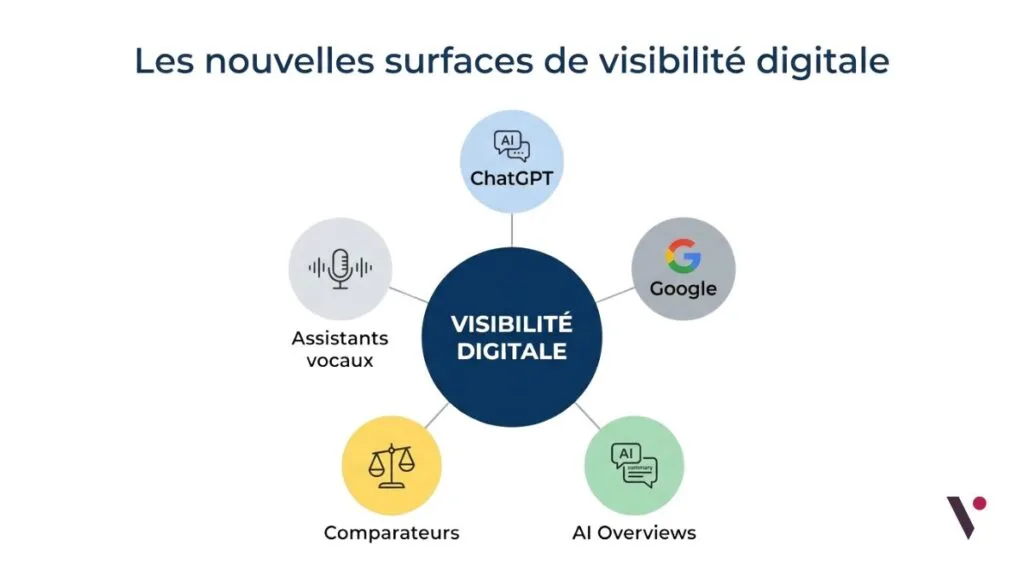
Another major development: digital visibility is finding a new channel with AI. And all multichannel strategies must be built around this new, omnipresent, and already almost dominant player.
A company can now appear:
- in regular Google results
- in the responses generated by ChatGPT
- in social networks
- in the comparison sites
- in AI or voice assistant recommendations
Therefore, companies' digital marketing strategy should be conceived as a two-pronged strategy:
- Communicating through traditional channels to connect with potential clients
- Coordinate the content across each channel to ensure it properly feeds AI with clear and structured information. Only with this second level of strategy can a company be recommended for AI responses.
The goal is no longer just to generate traffic, but to be identified as a reliable source of content and service by artificial intelligence systems.
SEO, GEO and AI visibility: how digital strategy is evolving
In light of these developments, companies' digital strategies in 2026 must incorporate new levers. Search engine optimization (SEO) remains fundamental, but it is now part of a broader ecosystem.
Traditional SEO
SEO aims to improve a website's visibility in search engine results (Google, Bing, etc.).
An effective SEO strategy is based on:
- technical optimization of the site
- the quality of the content
- the structure of the pages
- internal and external links
In this respect, SEO remains one of the essential foundations of any digital strategy.
AI-powered SEO (GEO)
With the rise of conversational engines and the use of AI to find businesses and product recommendations, a new discipline is emerging: optimization for generative engines.
AI-driven SEO , sometimes called GEO (Generative Engine Optimization), involves optimizing content so that it is:
- understandable by AI models
- structured in a clear way
- easily quotable in generated responses
The goal is to maximize a company's visibility in search engines. Specifically, this means ensuring that a company is highly recommended during AI searches related to its area of expertise. To use the shoe example again, the goal for a shoe store in Bordeaux is to be recommended during the customer journey, the search for the perfect pair of shoes.
Optimization for conversational engines
Content today must be designed to be:
- readable
- structured
- coherent
- specific
- reliable
Articles containing clear definitions, structured lists, and direct answers to user questions are more likely to be picked up by AI engines. But be careful not to forget that they must also contribute something new. Because AI won't need to refer to your content if it has already generated everything itself, without any personal additions! This is the mistake too many companies make when generating content with AI!
The changes that companies must make from 2026 onwards
To remain competitive, companies must adapt their marketing strategy. Several transformations are becoming essential.
Moving from a content strategy to a knowledge architecture
Many companies publish articles without a real structure. In the age of AI, building a knowledge architecture is becoming essential . It's an entity-based approach.
That means :
- create pillar pages
- organize the content into clusters
- structuring the themes
This organization makes it easier for search engines and AI to understand the site.
Example:
In SEO, we talked about keyword optimization for "shoe store Bordeaux". And from there we expanded with "pumps", "sneakers", "sports shoes", "5cm heels", etc.
Today, following the logic of entities with the same positioning:
Store: CSR commitments, gender equality, atmosphere, quality of customer service, type of sales staff, location, store size, number of shoes, distinctive features (if recognizable architectural style), personalized advice
Shoes: leather origin, preferably vegan leather in line with social commitments, made in Italy, comfort emphasized, excellent for walking for hours, instantly recognizable classic and timeless style
Bordeaux: close to all amenities and the tram, at the heart of an ecosystem of other boutiques, it is part of a collection of other premium shops
Why all this?
Because the AI you're asking the question to knows you very well. It knows that: you're primarily interested in comfort, you hate wasting time, you enjoy the feeling of being pampered, you truly appreciate the architectural beauty of Bordeaux, and you like getting around by tram. In short, you don't even have to repeat yourself; it's stored in its memory.
So when you ask him for help finding the right pair of shoes, he doesn't just respond to what you've written down; he looks for what best matches what you truly want and prefer. Therefore, the more precise the store is on each of these points, the more highly recommended it will be. The same applies to your business.
Create credible and citable content
The content that performs best today is not the most abundant. It is the most useful, credible , and accurate.
The most effective formats include:
- expert guides
- studies or analyses
- comparative
- Detailed FAQ
These formats allow AI engines to easily retrieve the information they need. But be careful not to forget to inject a little bit of yourself into each piece of content. That way, you'll already be part of the data when one of your potential clients asks a question you can answer!
Strengthen brand authority
In an environment where AI engines select their sources, authority becomes a key factor.
Companies need to strengthen their credibility by:
- showcasing their experts
- publishing case studies
- documenting their experience
- developing their editorial presence
A brand recognized as an expert will be more likely to be cited in the responses generated by AI.
Rethinking Marketing KPIs
The evolution of search is also changing how marketing performance is measured. A growing proportion of searches now end without a direct click to a website.
These situations are called zero-click searches . Currently, there's talk of a 67% drop in clicks on Google due to AI Overview (the immediate display of an AI-generated result at the top of the page). This seriously challenges practices like advertising and ad spending.
In this context, companies need to broaden their indicators:
- brand visibility
- quotes in AI responses
- share of presence in the results
To better understand these developments, you can consult our analysis of common errors in reading KPIs in the age of AI.
Mistakes that companies must avoid in 2026
Certain mistakes can severely hinder a company's visibility in this environment.
Producing too much AI-generated content
AI allows for rapid content production, but quality remains essential. Generic or superficial content will have little value for search engines.
As we mentioned, AI will have no interest in reviewing content that is 100% identical to what it already has "in its head." You can use it to provide the framework, but you must add your own touch, your unique perspective, your nuance to the content before publishing it.
Neglecting SEO
Some companies believe that AI will replace SEO. In marketing, nothing is ever that definitive, black and white.
There is still very little data on how AI uses content indexed by Google. We know that the higher a piece of content ranks, the better. AI searches the top 10 results and some rich results. However, we also know that this isn't enough to be recommended, or even recommended effectively, by AI.
So SEO remains an asset of your digital strategy, but it is not enough on its own.
Ignore chat engines
Focusing solely on Google can limit visibility.
Companies must also consider new research environments.
Not structuring their expertise
Websites that accumulate content without a clear structure are harder for AI engines to understand. And AI doesn't have time to waste trying to unravel it for you. It simply moves on. So, a clear content organization is essential.
You want to make things easy for them, and deliver the right information to the right place to ensure you get a proper recommendation. The last thing you want is for AI to sell you based on 5-year-old information!
What will a successful marketing strategy look like in 2026?
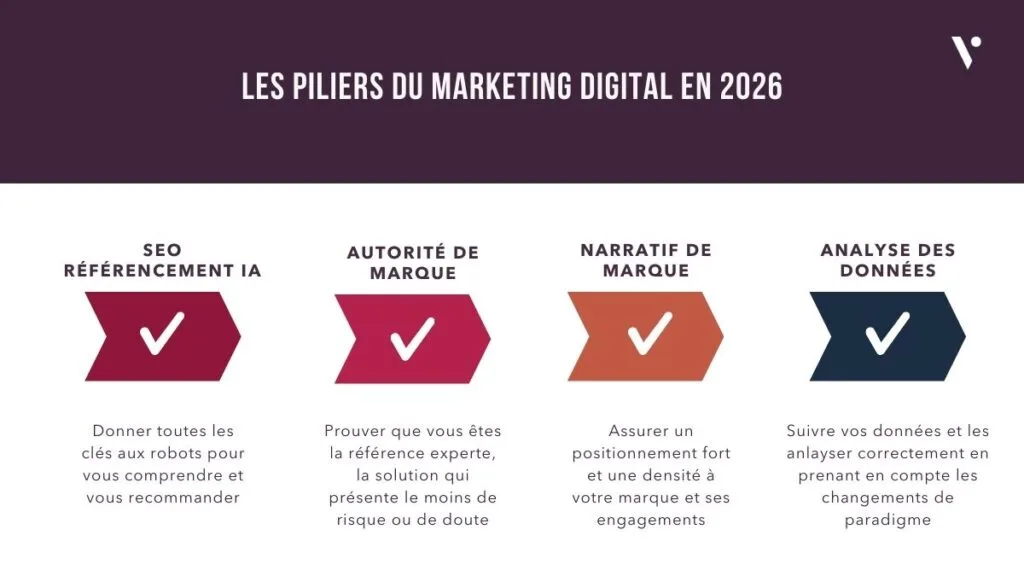
A successful digital strategy today combines several dimensions.
It is based on:
- solid SEO
- AI search engine optimization (AI SEO)
- a coherent and structured content in entities
- a clear editorial strategy
- a relevant analysis and interpretation of marketing data
The companies that will succeed will be those able to adapt their strategy to this new environment.
If you wish to adapt your strategy to these developments, our digital strategy agency supports companies in transforming their marketing in the age of artificial intelligence.
Digital Marketing FAQs in 2026: Frequently Asked Questions from Our Small Businesses and Event Professionals
Is SEO still useful with AI?
Yes. Artificial intelligence engines partially use content indexed by search engines to generate their results. However, SEO alone is not enough to be recommended in AI search results.
What is the difference between SEO and AI-powered search engine optimization?
SEO aims to improve a website's visibility in traditional search engines like Google.
AI SEO aims to optimize content for conversational engines that generate synthetic responses from the web.
More about The difference between SEO and GEO is explained in our article..
Will AI replace digital marketing?
No.
Artificial intelligence is transforming marketing practices, but it does not replace strategy, customer understanding, or creativity.
Rather, it becomes a new acquisition channel to optimize, and around which to build effective digital strategies.
How can I find out if my business is visible in AI search engines?
The best way to assess it is to conduct an AI visibility audit.
This audit analyzes the presence of a brand in the responses generated by artificial intelligence engines and identifies opportunities for improvement. Contact us to discuss it together.
Are backlinks still useful for AI SEO?
Yes. Backlinks remain important because they strengthen the authority and credibility of a website.
Artificial intelligence engines often rely on reliable and well-positioned sources to generate their responses. External links therefore continue to have an indirect impact on visibility in AI search enginesThese are indicators of legitimacy.
Today, the quality and credibility of the links And mentions matter more than their quantity.
Conclusion
Digital marketing is undergoing a major transformation. The rise of artificial intelligence engines is changing the way users search for information and discover businesses.
The fundamentals remain essential: good content, a structured strategy around several acquisition channels, a clear value proposition.
But to remain visible, companies now need to go further. They need to build a digital strategy capable of working both in traditional search engines and in existing and future conversational systems.
Looking to adapt your digital strategy to the age of AI? Discover how Ellevate supports companies in their marketing transformation.
Key takeaway: Digital marketing in 2026
- The quality of the content takes precedence over the quantity.
- SEO remains important
- AI is transforming research
- Brand authority becomes key
- Visibility is achieved through more channels than traditional marketing channels.
- The quality of the content takes precedence over the quantity.