Ellevate launches BotWatch to measure the effectiveness of SEO and GEO investments
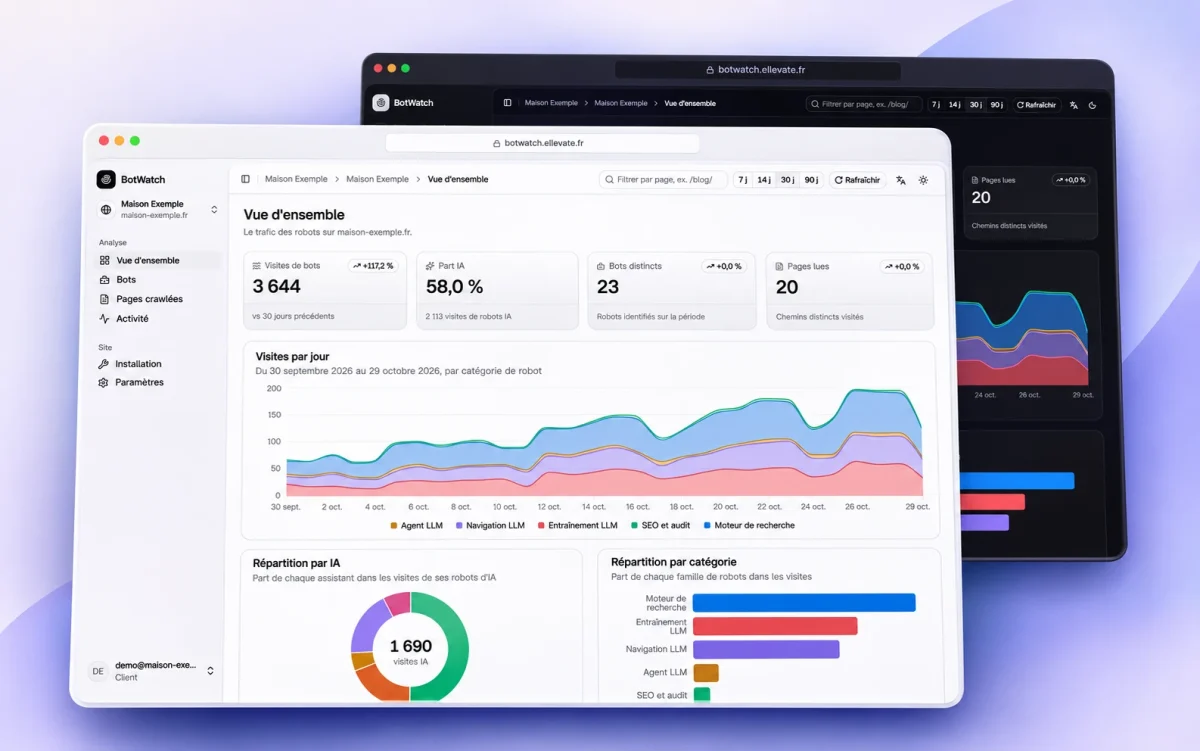
Ellevate announces the launch of BotWatch, an AI bot tracking tool designed to help businesses measure the effectiveness of their SEO efforts. Its goal: to provide concrete data, independent of AI vendors, to enable better SEO and geo-optimization decisions.
You have invested in optimizing your website. You have reworked your content, improved your SEO, and adapted your pages to new search engines and artificial intelligence.
But in practical terms, how can we know if these efforts are bearing fruit?
This is a question that companies, and especially our clients, are asking more and more. And one that traditional measurement tools cannot answer precisely today.
With the development of AI-powered search engine optimization (SEO), companies have many new metrics at their disposal: visibility scores, citation frequency, and ranking in ChatGPT or Perplexity responses. However, a crucial piece of data is often missing to fully understand the results.
Do artificial intelligence systems actually consult the content you invest in?
To fill this blind spot, Ellevate is launching BotWatch.
Why did we create BotWatch?
At Ellevate, we had been seeking for over a year to obtain sufficiently reliable and accurate data to better manage our clients' SEO and GEO investments.
Because while performance measurement has always been essential in digital marketing, the arrival of artificial intelligence seriously complicates the exercise.
New specialized tools now make it possible to determine how frequently a brand appears in AI search results, to monitor competitors, and to track visibility scores . These tools are valuable, and their metrics are essential components of an SEO strategy. However, they also have several limitations.
First, AI responses are not fixed. The same question asked multiple times to ChatGPT can produce different results, depending on the context or wording. A visibility score therefore provides an indication, but is not a comprehensive measure of what users see.
Furthermore, even when this score changes, it remains difficult to determine which actions actually contributed to the result.
You've updated ten pages of your website and your AI visibility is improving. Great. But which pages were actually viewed? Which ones are still being ignored? Should you invest more in the same content, or focus your efforts elsewhere?
This information is what allows us to move from reporting to management. And that's precisely where we encountered a problem.
We no longer wanted our clients to depend solely on the goodwill of AI builders to obtain information about their SEO, nor on expensive and complex software that multiplies indicators without necessarily simplifying decisions.
Jade Caillot, founder of Ellevate
We wanted reliable, readable, and useful data. Information that we could use to optimize our clients' strategies, without needing a manual or a team of analysts to interpret it.
BotWatch was born from this.
Data essential to SEO goes unnoticed by traditional tools
In June 2026, Cloudflare observed that bots were responsible for more than half of the web page requests on its network.
Obviously, not all of them are AI robots. But this development highlights an important change: websites are now accessed by an audience composed of both humans and machines.
Googlebot and Bingbot crawl pages for traditional search engines. GPTBot and ClaudeBot collect content for artificial intelligence models. Other systems, such as ChatGPT-User, can access pages when a user queries an AI assistant.
However, these trends are not visible in your usual dashboards. We have analyzed data from the main observatories for you and compiled it in this document dedicated to AI traffic trends in 2026.
Google Analytics automatically excludes traffic from known bots. Google Search Console provides valuable information about Google rankings, but doesn't give a complete view of the searches performed by different families of AI bots.
In other words, part of your site's activity that can contribute to its visibility escapes your marketing reporting.
However, this data exists. Every request made by a bot can leave a trace on your website's server.
BotWatch is based on this principle: to directly retrieve information available on your own site rather than relying exclusively on measurements from third-party platforms.
BotWatch: Check what AI is actually looking at to make better investments
BotWatch identifies the bots that visit your website, the pages they request, and how their activity changes over time.
The tool distinguishes in particular between search engine robots, those dedicated to training models, those that consult information in response to a request, and AI agents.
The goal is not simply to know how many robots visit your site.
The goal is to understand what these consultations teach you about the effectiveness of your SEO actions and the next optimizations to be made.
Let's take three examples.
You've optimized a strategic page, but AI bots aren't crawling it.
You have just dedicated time and budget to redesigning a page showcasing a major offering from your company.
With BotWatch, you can see that none of the tracked AI bots visited this page during the observed period.
You then know that you must start by checking if it is properly accessible, linked from the rest of the site or sufficiently highlighted.
Rather than continuing to produce content blindly, you have a concrete element to prioritize your next actions.
You've updated some content, but the AI is still accessing the old version.
Your offer has changed. You have published a new page, more complete and more relevant.
However, the data shows that the robots continue to regularly consult the old version.
This information may lead you to review your redirects, your internal linking, or the structure of your content in order to better direct robots to current information.
You are losing consultation opportunities due to technical errors.
BotWatch also identifies bot requests that result in non-existent pages or errors.
A deleted old URL, an incorrect address, or a page that has become inaccessible can prevent a robot from accessing the information it is looking for.
This allows you to identify the technical corrections that need to be made to prevent these problems from persisting.
These examples illustrate the same logic: invest where data shows a need, rather than deciding based solely on assumptions.
Can the ROI of GEO efforts be measured with BotWatch?
This is the objective that guided our thinking, with one important distinction:
The return on investment of an SEO or GEO strategy is not simply a matter of how often a search engine crawls the site. Ultimately, it is measured by the visibility gained, the qualified traffic, the business opportunities generated, and the revenue produced.
BotWatch does not claim to directly attribute a sale to a visit from an AI bot. Nor does it provide access to users' private conversations with ChatGPT or Gemini.
On the other hand, it provides a piece of data that has been difficult to access until now: the content that the identified robots actually come to view on your site.
By combining this information with traffic, conversion and visibility data in AI responses , companies can better understand the effects of their optimizations and identify investments to pursue, correct or redirect.
Therefore, it is not a question of supplementing the performance measurement with a data source directly from the company's site.
Data independent of AI manufacturers, accessible to all companies
The other conviction behind BotWatch concerns the accessibility of data.
The development of GEO has led to the emergence of numerous specialized solutions. Some are particularly comprehensive, but their cost and complexity can be difficult to justify for an SME or a small marketing team.
We therefore opted for a simple tool, focused on useful indicators and financially accessible.
BotWatch offers a dashboard that allows you to quickly view the identified bots, their activity, and the pages visited.
The installation process is guided, particularly for WordPress sites and compatible Cloudflare configurations. Data is hosted in Europe.
Two options are available:
- BotWatch, at €29 excluding VAT per month: access to the dashboard and autonomous robot monitoring.
- BotWatch with Ellevate support, at €170 per month: dashboard, personalized reading of results by an analyst with optimization recommendations and monitoring of changes.
Companies can therefore choose between autonomous data analysis and strategic support to transform it into action.
A new step in our approach to SEO and GEO
At Ellevate, we have always championed marketing that must be clear, measurable and controllable.
Artificial intelligence is transforming search practices and the customer journey. Companies must now work on their visibility both on traditional search engines and in the responses generated by AI.
But this development should not lead to investing in strategies whose results become impossible to interpret.
On the contrary !
With BotWatch, we wanted to make a new source of data accessible to better understand how robots explore sites and make more informed SEO decisions.
Because the question isn't just whether you're visible in AI. It's also about understanding what's happening on your site, what your efforts are producing, and where to invest next.
FAQ: Understanding and measuring your AI SEO with BotWatch
How can I tell if AI bots are visiting my website?
AI bots leave technical traces when they access a website's pages. This information can be analyzed to identify the bots present, the pages requested, and the frequency of their visits. BotWatch allows you to view this data in a dashboard, without having to manually analyze the server's technical files.
What is the difference between BotWatch and visibility tracking tools in ChatGPT?
AI visibility tracking tools primarily analyze responses produced by ChatGPT, Gemini, Claude or Perplexity: brand mentions, quotes and evolution of their presence.
BotWatch measures another step: the searches performed by identified bots on your site. These two approaches are complementary. One allows you to observe the visibility of your brand in search results, the other to understand which content on your site is actually being explored.
Why are AI bot visits not visible in Google Analytics?
Google Analytics is primarily designed to measure the behavior of human visitors and automatically excludes known bots. Therefore, AI bot traffic is largely absent from its reports.
To observe these consultations, it is necessary to use technical data from the site, such as that used by BotWatch.
If an AI visits my site, does that mean it will recommend me?
A web crawl by an AI bot doesn't guarantee that your page will be cited or that your company will be recommended in a response. However, no page can be cited without first being crawled by a bot. Therefore, it's a crucial indicator for analyzing the optimization of your website's pages.
Is BotWatch suitable for SMEs and marketing teams without technical skills?
Yes. BotWatch was designed to make this data accessible to executives and marketing teams, without requiring server log analysis skills.
Installation is guided and can be supported via video call upon request, and the dashboard presents key indicators in a clear and easy-to-read format. Companies can monitor their data independently, starting at €29 excluding VAT per month, or benefit from Ellevate support to interpret the data and prioritize their optimization efforts.
📊 What if AI and data finally became useful to your brand?
At ELLEVATE, we help you integrate these tools into your marketing, without bullshit or loss of soul, but with effectiveness.
Let’s discuss your data & AI challenges