Share of Model: How to measure your AI visibility in 2026

Share of Model is the frequency with which your brand appears in responses from ChatGPT, Perplexity, or Gemini, compared to your competitors, to the questions your prospects are asking. In other words, it's the concrete measure of your AI visibility, and an indicator increasingly monitored by marketing teams in 2026.
For the past few weeks, this term has come up in almost every conversation I've had with marketing teams. One client described it as the latest useless trend for generating buzz, while another saw it as the revolution all marketers have been waiting for for the past three years. They're both partly right, and partly wrong (a typical Norman answer, yes, I know!).
The Share of Model is real and it works, yes. It's a serious attempt to answer a critical question: when someone asks ChatGPT, Perplexity, or Gemini to recommend a brand in your industry, do you appear in the answer?
But it's also an area where many tools promise accuracy they don't actually possess. A study published in January 2026 by Rand Fishkin (SparkToro) shook things up by demonstrating that half of what the market sells under that name is statistically unsound. That's why I wanted to discuss it with you in detail. This way, you can more easily protect yourself from those who sell you snake oil!
This article untangles the two: what Share of Model really measures, where it comes from, how to calculate it properly, and most importantly, what you should ignore in the surrounding discourse.
👉 If you're not yet familiar with the difference between traditional SEO and AI-driven SEO (GEO), start with our article on the difference between SEO and GEO . It lays the essential groundwork for what follows.
| What you will find in this article – Why is this KPI emerging now, and what are the figures that explain it? – The precise definition of Share of Model, and how it differs from Share of Voice – Where does this term come from, and who formalized it? – How to calculate it in practice, method and tools – What the January 2026 SparkToro study changes in the way we measure it – The most frequent errors in its monitoring – What this means for your content strategy |
|---|
1. Why is this AI visibility indicator appearing now?
For twenty years, measuring online visibility meant one thing: tracking your ranking on Google (page 1, position 1, position 0, etc.). Ten blue links, a position, a search volume, a click-through rate.
But this model has gone beyond the stage of "struggling". It's time to be gently retired.
According to an analysis by Rand Fishkin (SparkToro) using the Similarweb clickstream panel , 68% of Google searches performed in the United States during the first four months of 2026 ended without a single click . This means no clicks to your site, nor to a competitor's. The user gets their answer directly within the interface and doesn't need to go any further.
At the same time, traffic arriving from AI search engines exhibits radically different behavior from that of traditional search (Google). Several independent studies converge on the same order of magnitude: AI-referred traffic converts at around 14%, compared to approximately 3% for a traditional Google search —a gap already observed in early 2026 by RZLT and the Swiss media outlet Organisator . In concrete terms, when a user arrives from an AI chat, they are more likely to make a purchase than when they arrive from Google.
It's no wonder marketing teams are panicking a bit. You can perfect your #1 ranking on Google for "best event agency Bordeaux." But if you have a competitor who's recommended in all the AI chat rooms (ChatGPT, Gemini, Claude, etc.), you won't see it in your stats. Because users will stop at the AI recommendation and won't find you.
The tragedy is that this loss is invisible. There's no notification when a generative AI recommends someone else instead of you. No bounce spike, no ranking drop to investigate. The prospect simply never enters your conversion funnel because the machine that created their shortlist didn't mention you.
This is precisely the void that Share of Model is trying to fill.
👉 This shift in how you interpret your metrics is the central topic of our article on how to relearn how to read your KPIs in the age of AI . If a drop in organic traffic is currently worrying you, this additional insight is essential.
2. What exactly is Share of Model?
Share of Model measures how often your brand appears in AI-generated responses, compared to your competitors, across a set of queries representative of your category.
It is literally the equivalent, for the generative era, of what Share of Voice was for twenty years for advertising and Share of Search for SEO: a share of presence in a decision space that you do not directly control.
The difference in logic compared to traditional SEO is fundamental. A conventional search engine shows you ten results and lets the user choose. A generative engine almost never shows ten results: it synthesizes a single answer and cites (or doesn't cite) a handful of sources or brands within that answer. The winning result captures all the attention in the response. The others become, in effect, invisible for that specific interaction.
| Share of Voice / Share of Search (Google) | Share of Model (AI) |
|---|---|
| Measures presence in a multi-result space (SERP, media) | Measures presence in a single synthetic response |
| The user sees all the options and chooses | The AI has already pre-selected and prioritized the options for him |
| Measured by position and volume | Measured by frequency of occurrence across a range of queries |
| Relatively stable over time | May vary greatly from run to run (see section 5) |
In concrete terms, Share of Model does not measure a single thing. According to the most rigorous methodological frameworks published in 2026, it actually encompasses several distinct signals that should not be confused:
- The frequency of mention : out of X tested queries, in how many results does your brand appear?
- The prominence Are you cited first, or as a last resort at the bottom of a list? Models tend to treat the first entity mentioned as the default recommendation.
- The associated feeling Does the AI describe you favorably, with reservations, or neutrally?
- The cover of prompts Overall, how many purchase-intent search queries in your category do you appear on?
None of these four signals, taken individually, tells the whole story. It is their combination that gives an accurate picture of your position.
3. Where does the term "Share of Model" come from?
The Share of Model is not an academic concept that fell from the sky. It has an author and a specific date.
Author: Jack Smyth , then Chief Solutions Officer at Jellyfish (Brandtech group), formalized the concept in late 2024 with his colleague Tom Roach . Roach detailed its genesis in Marketing Week . Jellyfish then launched a commercial platform of the same name , tested in beta with brands such as Danone and Pernod-Ricard (Chivas Brothers).
History: This is not a completely new invention either. The term is part of a lineage of "share of presence" metrics that goes back to classic advertising and the concept of Excess Share of Voice (ESOV) theorized in 1993. This share was the difference between a brand's share of voice and its actual market share.
The Share of Model therefore adopts this same founding intuition, applied to a completely new channel:
Is your presence in AI models proportionate to what you should be carrying in your category?
Since the end of 2024, the term has spread far beyond Jellyfish. You will also encounter it under the names "share of citation", "AI share of voice" or "share of answer", different names for the same measurement intention.
4. How to calculate your Share of Model
There is not yet a single certified standard, but a method has become de facto established in most frameworks published in 2026.
The 5-step method
Step 1: Build a list of queries ("prompts golden set").
Between 10 and 15 requests to start, ideally 50 or more for serious B2B follow-up.
To give you an idea, the proprietary tool we developed in-house at Ellevate for our AI visibility audits tests over 160 elements for maximum granularity. We then analyze these elements in detail to find the best leverage point for your visibility.
The distribution that most often appears in the 2026 frameworks :
- 20% of brand queries "What do you think of [your brand]?"
This only confirms that the AI knows you, not that it recommends you. - 60% of solution requests "How to find an AI SEO agency for SMEs?"
This is where your visibility to prospects who haven't yet decided to seek you out comes into play. - 20% of comparative queries "What is the difference between [you] and [competitor]?"
Step 2: Run these queries on multiple engines.
At least ChatGPT, Perplexity, Claude and Google AI Overview / AI Mode.
One point that many marketing dashboards overlook: each model has its own memory of your brand , built on different training data and sources. An INSEAD study showed that the laundry detergent brand Ariel achieved nearly 24% Share of Model on Meta Llama, compared to less than 1% on Gemini . Same brand, same category, same time period, different Share of Model.
Being visible "in AI" = you are visible, or not, model by model.
Step 3: Repeat each request several times
Ideally, 60 to 100 runs per query are needed for a statistically reliable reading. See section 5; this is currently the most misunderstood point in the market.
Step 4: Calculate the occurrence rate.
Share of Model = (Number of responses where you appear ÷ Total number of responses tested) × 100
Step 5: Track over time, and correlate with your actions.
The main interest of the Share of Model is not the isolated figure, but its variation after a specific content action :
- adding structured data,
- publication of a key article,
- obtaining a press mention,
- etc
If your Share of Model on a target query increases from 30% to 55% after a redesign of your service page, you have concrete proof that the action worked.
Tools available in 2026
| Tool | Positioning | Features | Points requiring special attention |
|---|---|---|---|
| depth | AI visibility platform, a specialty adopted by some Fortune 500 companies | Multi-platform monitoring and AI visibility analysis for organizations with advanced reporting needs | Carefully review the methodology and coverage chosen for your market. |
| Otterly.ai | Multi-engine AI quote tracking, geared towards SMEs and mid-market | Follow prompts, mentions, and citations with easy access | The value depends directly on the quality of your corpus of prompts. |
| Ahrefs Brand Radar | AI Visibility module integrated into the existing SEO suite | Track mentions, quotes, AI Share of Voice, and personalized prompts across multiple assistants | Some "impressions" are modeled from search data: these are not views actually measured in ChatGPT |
| Google Search Console | AI visibility in Google (AI Overview, AI Mode) | Measure impressions of your URLs in certain generative Google features when the report is available | It does not cover ChatGPT or Perplexity and does not, on its own, measure the business impact |
| Manual tracking (Google Sheets) | Free, transparent methodology, requires discipline | Read a response carefully, investigate an error, test a new intention | It will not produce a robust trend if the volume and repetition are too low |
For a very small business or a small to medium-sized enterprise (SME), structured manual tracking in a spreadsheet, with around ten monthly queries, provides more than enough data to get started, and above all, a methodology you control from beginning to end, unlike a purely commercial approach. This is a reality you must begin to grasp today because it will be the only truly effective marketing optimization strategy going forward.
5. What the January 2026 SparkToro study reveals
This is the most important point of this article, and probably the one that the majority of GEO providers do not explain to you today, because it weakens part of their sales pitch.
In January 2026, Rand Fishkin , co-founder of SparkToro, published with Patrick O'Donnell (Gumshoe.ai) the most rigorous study to date on the reliability of AI visibility tracking.
The protocol: 600 volunteers ran 12 identical prompts on ChatGPT, Claude and Google AI (Overviews / AI Mode), a total of 2,961 runs, on categories ranging from kitchen knives to cancer hospitals.
The result sent a chill through the "AI tracking" industry, a sector estimated at over $100 million in annual spending.
Ask ChatGPT to recommend brands in a category 100 times: you have less than a 1 in 100 chance of getting the same list twice. To get the same order twice: approximately a 1 in 1,000 chance.
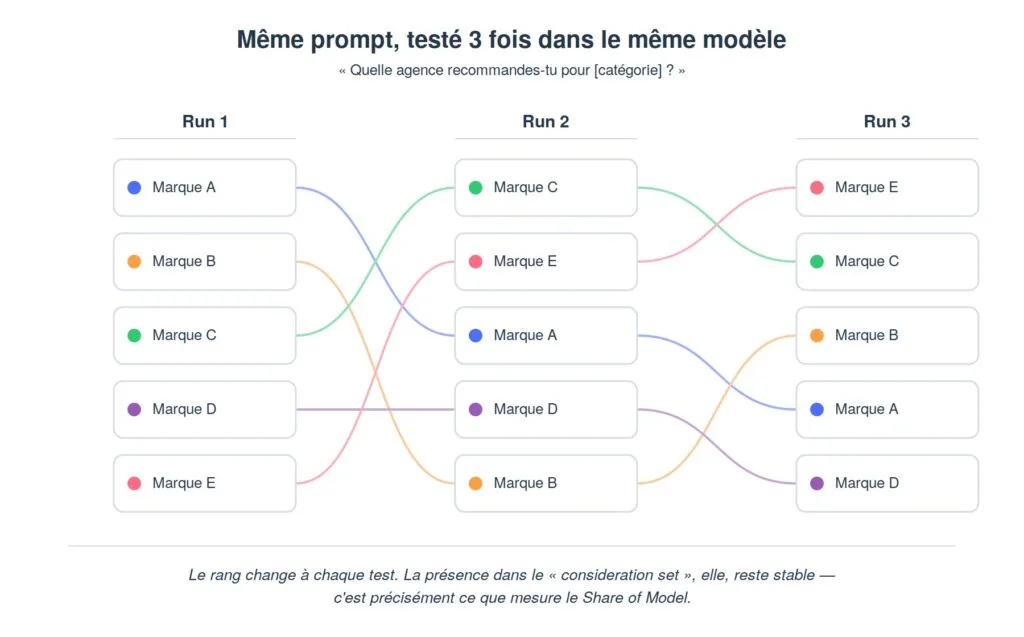
Fishkin was direct about what this means for rankings, in a cover story picked up by Search Engine Land :
“any tool that gives a 'ranking position in AI' is full of baloney”, Rand Fishkin
In other words: if a tool promises you a "position #3 in ChatGPT" for your target query, this figure has no statistical value. It reflects a random snapshot, not a stable ranking like you might have on Google.
What, on the other hand, resists analysis
The study does not invalidate the Share of Model. It invalidates a naive version of the Share of Model: the one that tracks a rank . What holds up statistically is the frequency of occurrence , measured over a sufficient volume of runs (tests, iterations).
Fishkin introduces a key concept to understand why: AI does not maintain a stable hierarchy, but rather draws from a "consideration set" for each response —that is, a set of brands deemed relevant to the category. And this "consideration set" remains relatively constant.
In more narrow search categories (cloud providers, regional B2B providers, premium event agency Paris), the brands at the top of the consideration set appeared in 55% to 77% of responses , regardless of the exact wording of the prompt.
In the broader categories (science fiction novels, design agencies), the overall picture was more dispersed, but leaders still emerged with significantly higher rates of appearance than the rest of the market.
The practical conclusion: you do not optimize for a rank, you optimize to enter, and remain, in the consideration set of a given model.
This reality changes the indicators you need to track, and therefore report on internally.
Reporting "we are #2 at ChatGPT on our core business query" to your management, based on a single test, is like reporting a lottery draw as a performance.
Reporting "we appear in 62% of the responses tested over 80 runs, compared to 34% a quarter ago" is a defensible figure.
| What the SparkToro study (Jan. 2026) invalidates | Which she confirms |
|---|---|
| The "rank" or "position" in an AI response | The occurrence rate measured on a large sample |
| A one-time or occasional test | Repeated monitoring (60-100 runs recommended per query) |
| A consistent reading of "your visibility in AI" | A reading by model (ChatGPT ≠ Gemini ≠ Perplexity) |
6. The 4 most frequent errors in tracking Share of Model
Only follow brand queries
Asking ChatGPT, "What do you think of [my brand]?" confirms that the model is familiar with you. It tells you nothing about your ability to be recommended to a prospect who doesn't yet know you and is looking for a solution. It's the solution query ("how to find a service provider for…") that captures the earliest, and therefore the most strategic, intent.
Treat a single test as reliable data
After the publication of the SparkToro study, this became the number one methodological error. A single test provides a random snapshot, not a measurement.
Measure a single model and generalize
The Ariel Llama/Gemini gap (24% vs. less than 1%) is enough on its own to demonstrate why measuring only ChatGPT and drawing conclusions about "your AI visibility" in general is a classic sampling error.
Never correlate Share of Model with actual business results
A recent Similarweb study, conducted by Rand Fishkin in the finance, travel, and beauty sectors , shows that direct visits and brand searches increase more for companies mentioned in AI responses than for those that are not. This is an encouraging sign regarding the real impact of Share of Model. However, the study itself emphasizes that the cause-and-effect relationship still needs to be confirmed in other sectors and brand sizes. Always track your Share of Model alongside your traditional metrics (direct traffic, brand searches, leads), never in isolation.
👉 This discipline of cross-reading KPIs is exactly what we detail in our article on how to relearn how to read your numbers in the age of AI.
7. What this changes for your content strategy
The Share of Model is a thermometer. It doesn't cure anything on its own. The real question, once you know where you stand, is: how do we increase that number?
The answer aligns with what we've been saying since the beginning of our AI SEO series: clarity precedes volume . AI doesn't recommend the loudest brand; it recommends the one it understands best and can unambiguously link to a category, positioning, and evidence. This is the central theme of our article on what brands need to understand to be recommended by AI.
Specifically, three levers have a proven effect on your presence in the consideration set of models:
- Think in terms of entities, not keywords. Generative models do not reason in terms of character strings but in terms of relationships between recognized entities. This is the paradigm shift that we detail in our article on the difference between keywords and entities.
- Structure each page as a self-contained answer. A quoteable definition of 2 to 3 sentences under each heading, extractable out of context. We detail this mechanism in our guide on optimizing articles for AI search engines.
- Build a corroborated presence outside of your site. Mentions on third-party platforms (customer reviews, trade press, industry forums), consistency in your messaging across all channels. It is these external signals, not your own statements, that build the authority a model ultimately adopts.
No "hack" can replace this fundamental work. The Share of Model only makes visible, at last, the effect of this work, or its absence.
FAQ – Share of Model: How to measure your AI visibility in 2026
Is Share of Model different from Share of Voice?
Yes. Share of Voice measures your presence in a multi-search engine results space (SERP, media, Google). Share of Model measures your presence in a single, synthetic AI response, where a single brand often captures all the attention.
Can we track a "ranking" or a "position" in AI responses?
No, not reliably. The SparkToro study (January 2026) demonstrates that the order of the brands mentioned varies almost every time the same prompt is run. Only the frequency of occurrence, measured over a large number of runs (tests), constitutes usable data.
How many times do you need to repeat a request for reliable tracking?
Available research suggests 60 to 100 runs per query to begin observing stable trends. Niche categories stabilize faster than broad categories.
Should we monitor multiple AI engines simultaneously?
Yes, absolutely. An INSEAD study shows that the same brand can have a radically different Share of Model from one model to another. Measuring a single engine and generalizing is a common methodological error.
Who invented the term Share of Model?
Jack Smyth and Tom Roach, at the agency Jellyfish (Brandtech group), formalized the concept at the end of 2024 , before launching a dedicated commercial platform.
Does Share of Model really predict my sales?
A 2026 Similarweb study shows a correlation between mentions in AI responses and increased direct traffic/brand searches in the finance, travel, and beauty sectors. Causality in other sectors remains to be confirmed: treat Share of Model as a complementary signal, not as standalone ROI evidence.
Can a small budget track its Share of Model without paid tools?
Yes. A spreadsheet with a dozen or so queries tracked manually each month provides more than enough reading to get started, with the advantage of a transparent methodology that you fully control.
Does Share of Model replace traditional SEO tracking?
No. It complements it. SEO remains one of the foundations of your online/digital visibility: without domain authority, without a solid content structure, without a third-party presence, there is nothing to feed the consideration set of AI models in the first place.
Conclusion: The Share of Model is a useful indicator, provided it is read carefully.
The Share of Model answers a real question, which has become urgent: whether you exist in the answers that generative engines give to your prospects, even before they arrive on your site.
But it's a relatively new KPI (Key Performance Indicator), still poorly standardized, and some in the market are selling a level of accuracy they don't possess. The lesson from the SparkToro study isn't to ignore this metric. It's to measure it correctly: by frequency, not by ranking; across multiple models, not just one; and over a sufficient volume of tests, not a single isolated run.
The rest of the work always takes place in the same place: the clarity of your positioning, the structure of your content, and the consistency of your presence on the sources that models actually consult.
| Do you want to know where you really stand on your Share of Model, and what to prioritize to make it progress? Our GEO & AI SEO support is the best entry point. |
|---|
📊 What if AI and data finally became useful to your brand?
At ELLEVATE, we help you integrate these tools into your marketing, without bullshit or loss of soul, but with effectiveness.
Let’s discuss your data & AI challenges