How do I determine my business growth model?

A company's growth model is one of the essential pillars for ensuring consistent and sustainable progress. Without a clear framework and a precise understanding of your growth drivers, you risk wasting time and resources on ineffective actions. Let's take a look at how to define, refine, and fully leverage your growth model to propel your company to success.
1. What is a growth model?
A growth model is a simplified representation of how your business works to achieve its development goals. It allows you to visualize the customer journey, understand entry points, acquisition channels, and, most importantly, identify optimization levers.
A well-structured growth model provides a holistic view of the conversion funnel and highlights each stage where you can maximize impact on your customers.
Example framework: AARRR
One of the most widely used frameworks for representing the growth model is AARRR (Acquisition, Activation, Retention, Revenue, Referrals), also known as "Pirate Metrics." This framework helps identify each stage of the customer journey and its associated metrics:
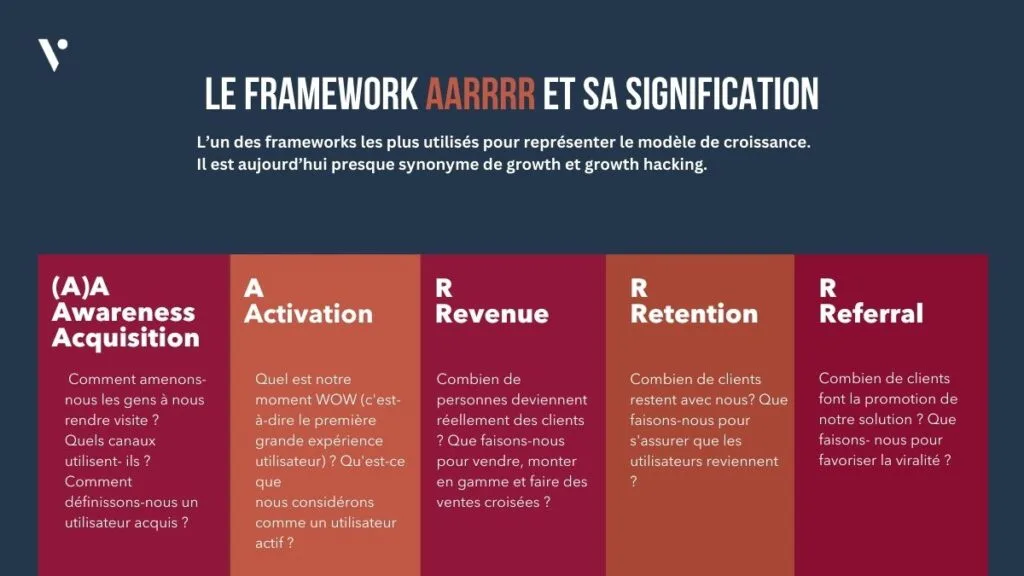
- Acquisition : How do your potential customers find out about your business?
- Activation : What mechanisms encourage your prospects to interact with your product or service?
- Retention : How do you keep your customers coming back?
- Returned : How do your actions convert into real transactions?
- References : How do you encourage your customers to recommend your product?
This framework allows you to optimize each stage of the funnel and adapt your growth strategies to different customer segments.
2. Map the Customer Journey
Defining your growth model begins with a crucial step: mapping the customer journey . This involves putting yourself in the shoes of your typical customer and understanding each stage they go through, from discovering your product to building loyalty.
This approach is valuable because it helps you better understand the channels through which your customers arrive (SEO, SEM, social networks, recommendations, paid advertising, etc.) and identify key moments where improvements can be made to maximize conversions.
Example: the “Golden Path”
To refine this mapping, an effective method is to define the ideal customer journey (or "golden path") that a customer would follow from beginning to end: from discovering your company to conversion, and then to loyalty. The goal is to understand how an organic customer, a customer acquired through referrals, or a customer acquired via paid campaigns interacts with your company.
You don't need an elaborate diagram; everything can fit into a table. The key is to centralize and schematize this information for you and your teams.
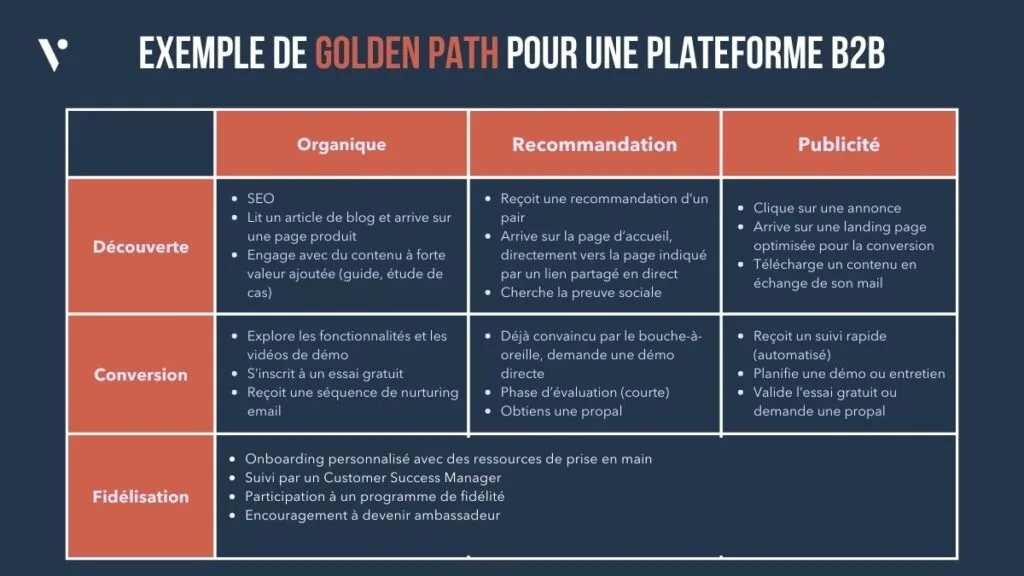
By building this ideal path for each customer segment, you will be able to detect pain points at each stage of the funnel and optimize these touchpoints to strengthen growth.
3. Identify Your Growth Channels
Every company needs to determine which growth channels are most effective. These channels vary depending on the industry and target audience, but testing different channels is essential to identify the best performers.
Examples of common channels:
- SEO and Content Marketing : ideal for attracting long-term customers by improving the organic visibility of your business.
- Paid advertising (SEM) : offers quick results, but requires a precise strategy to guarantee a satisfactory ROI.
- Email marketing and push notifications : particularly effective for customer activation and loyalty.
Each channel should be tested and analyzed to understand its effectiveness in your growth model.
4. Adjust Your Growth Model According to Market Changes
A company's growth model is not static. It must be reviewed regularly to adapt to changes in the market, customer behavior, and your own business objectives.
That's why it's recommended to review your growth model at least twice a year to stay in line with customer expectations. This review involves analyzing available data, testing new channels or strategies, and evolving your approach if necessary.
5. Measure the Performance of Your Growth Model
Defining a growth model is only valuable if you can measure its effectiveness. To do this, it's essential to implement relevant growth metrics at each stage of the customer journey.
The essential KPIs:
- Acquisition : Number of unique visitors, conversion rate of a specific channel.
- Activation : Rate of registration, download, or first use of the service.
- Retention : Percentage of recurring customers, churn rate.
- Returned : Average value per customer, number of transactions per customer.
- References : Number of recommendations, sharing rate on social networks.
These metrics allow you to know precisely which levers to activate to boost the performance of your growth model.
6. Plan for Long-Term Growth
Once your model is in place and your channels are optimized, the final step is to plan your long-term growth . This involves defining quarterly or annual objectives based on your OKRs (Objectives and Key Results). These objectives must be specific, measurable, and realistic.
Example of OKR:
- The goal : Increase the number of monthly active users.
- Key result : Reach 100 active users by the end of the quarter.
By reviewing these goals regularly and adjusting your actions based on the results obtained, you will have a clear and scalable growth plan.
Defining and refining your growth model is an ongoing process that relies on a solid understanding of the customer journey, the most effective growth channels, and the right metrics. With a solid model, you'll be able to drive your growth effectively and sustainably, adapting to market changes and your customers' needs.
📈 Ready to grow your brand without chaos?
Our growth experts help you formulate your hypotheses, structure your tests, and manage aligned growth.
Let's take 20 minutes to talk about it.
 Affiliate Marketing: Definition and ExplanationsFebruary 25, 2025
- What is Search Engine Marketing (SEM)?February 11, 2025
- Building Your Quarterly Growth Plan in 6 StepsOctober 29, 2024