AB Testing: the process for entrepreneurial success
A/ B testing is a game changer for entrepreneurs in 2024. After all, the idea is to make your marketing decisions based on evidence, not intuition.
An example? You're hesitating between two versions of your homepage. Instead of choosing based on gut feeling, A/ B testing shows you precisely which one generates the most conversions . This growth marketing approach , based on data and not assumptions, transforms curious visitors into paying customers.
Web giants like Amazon and Booking.com have understood this: continuous testing, measurement, and optimization are the difference between stagnation and exponential growth or hypergrowth. But how can you implement effective testing for your business? What mistakes should you avoid? In this article, we reveal everything you need to know to successfully conduct your first AB tests.
AB Testing in detail
Definition and interest
AB testing works like an experiment. You create an alternative version of an element and compare it to a standard (the original version). It's the principle of offering a "business as usual" version and a "test my hypothesis" version.
Perhaps the most telling example is email. You send two versions of the same email to two different groups. The one that performs best tells you the right direction to follow.
The goal? To gain efficiency! By refining and perfecting, you will move towards ultra-personalization of your content and increased performance.
What elements should an AB test be based on?
Titles and hooks
Your headlines make the first impression, whether it's for transaction pages, capture pages, or even newsletters and articles. A good H1 (the technical term for your main page title in HTML) grabs attention; a bad one scares visitors away. The idea is to test several versions to find the one that resonates the most, for example by measuring user session duration or overall behavior.
The textual content
The text on your pages directly influences visitor engagement, from simple product descriptions to lengthy sales pages, including storytelling and copywriting. Even a subtle change in wording or your CTAs ( Calls to Action ) can transform a hesitant reader into a convinced customer.
The visual elements
Which image or video should you put on your sales page? And where? Here too, A/B testing will allow you to experiment with different formats, styles, and placements to discover what best captures your visitors' attention and generates the most interaction.
The pricing structure
The way you present your prices impacts the purchasing process . From monthly versus annual pricing to "starting from" formulas, it's best to choose wisely. Here too, testing two solutions will ultimately help you select the most relevant format.
Emails
Your email campaigns are the perfect playground for A /B testing ! The subject line, the email preview, the forms, the calls to action, the best time to send... So many elements can be included in your experiments.
On this subject, we offer you a complete look at AB Testing for emails in this other article.
Layout
On a webpage, the placement of key elements, such as forms or call-to-action buttons, can either facilitate or hinder your visitors' journey. In other words, it can create friction . Hence the importance of testing different layouts to identify the one that naturally leads to conversion.
Pop-ups
Ah, pop-ups… Those annoying windows, but so powerful in marketing and lead generation ! You can play with the size of the pop-up, its conditions of appearance, its text, its value proposition, etc.
Beginner in AB Testing: Where to start?
In a word: start small, but start well!
It's best not to jump into complex tests right away. For example, start with your most visited page and a simple objective. For example: Highlighting newsletter subscriptions directly on the homepage should increase our number of subscribers by 50%.
Your first test in 4 steps
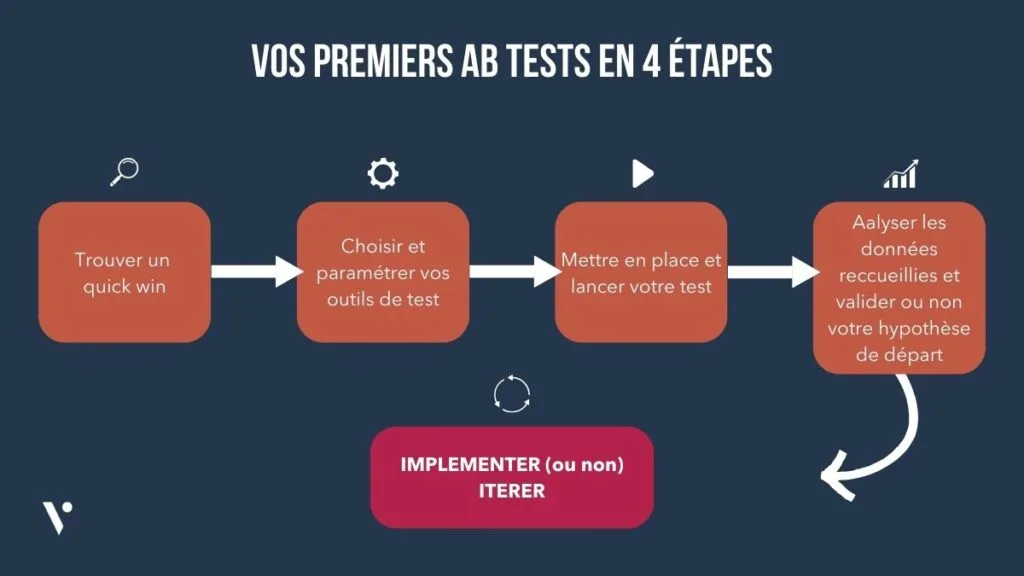
- Identify a “quick win”
A barely visible action button, a form that's too long, a catchphrase that's unclear enough... It's often in the basics that the best conversion opportunities lie. Take one and start testing alternatives over fixed periods.
- Install your tools
To properly track results, use Google Analytics (if you haven't already), or simply your CRM for lead collection (Hubspot or Brevo, for example).
Following the end of Google Optimize in 2023, you will be able to opt for affordable alternatives, such as Kameleoon or AB Tasty.
- Run a simple test
For example, let's take 2 possibilities for the main button of a home page:
Version A: Your current “Learn More” button
Version B: New version “I’m testing it for free”
All while following a goal of improving your click-through rate by 5%, for example.
- Analyze and learn
After 28 days, look:
Which version performs better?
Are there any differences by segment?
What lessons can we learn for the future?
The logical continuation
Once you have successfully completed this first test, you will gradually be able to:
- Test more complex elements.
- Refine your customer segmentation.
- Improve your process of testing.
- Explore other pages and features.
The key? Remain methodical and patient. A/ B testing is a marathon, not a sprint.
The winning method of AB Testing: key steps and pitfalls to avoid
1. Prepare your ground
Before embarking on A/B testing , a few precautions are necessary. Otherwise, you risk wasting your time and resources!
✅ The right approach
The bare minimum for testing? 1000 conversions monthly, to have a satisfactory level of statistics. But volume is not everything. Take into account:
- The quality of your traffic: bounce rate, time spent
- Sources: direct, SEO, paid, social
- Behaviors: page views, typical journey
- Seasonality: weekly and monthly variations
A good indicator? If your traffic is already generating regular conversions , even modest ones.
❌ The trap
Run tests on a startup site with 100 visits per day. The result? Insignificant data and decisions based on chance. It's like drawing conclusions from a survey with three respondents.
2. Define your strategy and objectives
A/B testing takes place within a broader framework. You could start with SMART objectives, a need to improve one part of your sales funnel, or even a growth hypothesis.
✅ The right approach
An effective test always answers these questions:
- What concrete problem are you solving?
- What specific metric do you want to improve?
- What ROI do you expect?
- How this test fits into your process overall ?
Concrete example: "Our product page converts at 2%. Funnel analysis shows that 60% of visitors don't scroll down to customer reviews. Hypothesis: by moving the reviews to the top of the first screen, we will increase the conversion rate to 3%."
❌ The trap
Testing without prior data. “Our button is green, let’s test it in blue” is not a strategy. It’s change for the sake of change, without any logic. performance.
3. Target with precision
A/B tests rarely target a broad audience. You'll get more meaningful results by targeting a specific type of prospect, based on their position in the purchasing decision-making process.
✅ The right approach
La customer segmentation is your best ally:
- New visitors: optimize the first impression
- Loyal customers: increase the average basket
- Mobile: adapt the experience to small screens
- Geography: Customize by culture
- Acquisition channel: refine by traffic source
For each segment, define specific objectives and appropriate KPIs.
❌ The trap
One size fits all. Your desktop and mobile visitors behave differently. A blanket test will mask these crucial differences.
4. Measure carefully
With AB Testing tools, you can rely on well-chosen metrics (KPIs) to evaluate the success or failure of an attempt.
✅ The right approach
The ideal duration? 28 days for:
- Cover all days of the week
- Include behavioral variations
- Avoiding calendar bias
- Achieve statistical significance
Monitor three levels of metrics:
- Main KPI: rate of Conversion, income
- Secondary metrics: engagement, satisfaction
- Alerts: abandonments, customer support
❌ The trap
Tunnel analysis. A test that boosts conversions but increasing product returns isn't a success. Connect your tools for a 360° view.
5. Document and iterate
You saw it coming... A single test is usually not enough. To refine your formula, you can align the different tests, taking into account the results obtained.
✅ The right approach
For each test, create a complete sheet:
- Detailed initial hypothesis
- Screenshots of the variations
- Quantitative results
- Qualitative observations
- Unexpected impacts
- Improvements Track
This documentation will become your bible of growth hacking.
❌ The trap
The “all or nothing” syndrome. A 2% gain on your Chief Revenue Officer ? Don't neglect it. Do the math:
- +2% on click rate
- +3% on the occupancy rate
- +1.5% on completion
Over the course of a year, these micro-optimizations transform your performance.
We talk about AB Testing tools in a dedicated article to help you make your choice.
Recap: The perfect test checklist
Before each test, check:
✓ Volume: +1000 monthly conversions?
✓ Objective: Problem identified and measurable?
✓ Segments: Clearly defined targets?
✓ Measures: Tools configured and tested?
✓ Team: All aligned on the duration and objectives?
This checklist may seem simple, but it's based on sound logic. Take the time to follow it meticulously. For example, when considering volume, don't just look at the raw number of conversions . Analyze their quality: where do they come from? Are they consistent? What is their average value? These details make the difference between a reliable test and a flawed one.
From solopreneurs to SMEs, AB testing provides many benefits... provided it's used properly. As you've probably guessed, your efforts should focus on preparation. What hypotheses are you hoping to test? What metrics do you want to improve? Who is the target audience? All of these questions can be addressed pragmatically and help ensure the success of your experiments.
The best course of action? Get expert guidance. Schedule an appointment with an ELLEVATE expert to successfully implement your upcoming A/B testing and truly leverage it for your business growth.
🧪 Need to structure your tests or your marketing organization?
Our experts will help you implement simple, effective processes adapted to your growth phase.
Let’s take 20 minutes to structure your methods
 Top 5 AB Testing Tools in 2025: Which One to Choose?November 26, 2024
- AB Testing email: a formidable business allyNovember 19, 2024
- AB Testing: the process for entrepreneurial successNovember 12, 2024


